
Starting and operating a business is a challenging process, even more so when navigating language barriers and unfamiliar systems—this is the community Growing Contigo aims to support.
Immigrant entrepreneurship in Washington State and Seattle has been on the rise as more resources emerge to help entrepreneurs build partnerships, secure funding and reach new markets.
Growing Contigo LLC is a small-business consulting firm that specializes in services, training and workshops for entrepreneurs, particularly in the immigrant Spanish-speaking communities, with a team made up of immigrants or the children of immigrants.
José Manuel Vasquez, the founder and CEO, started the company in 2022. It was a lifelong journey for him, he said. Growing up in South Seattle and South Park, he saw his parents struggle when navigating business systems and government agencies. His parents, who immigrated from Mexico, did not speak English. His father got his start in small business working as a mechanic in the driveway of their apartment complex.
“Like the child of any immigrant, at 10, 11 years old, I was translating legal documents for them. At a young age I was exposed to a lot, like learning who the Department of Revenue was, the Secretary of State and Labour Industries.”
Vasquez was born in Mexico and graduated from the University of Washington Foster School of Business in 2009 with a dual concentration in marketing and entrepreneurship.
After college, he worked for nonprofit organizations for about 10 years, which provided him with insight into the needs of the immigrant community—implementing and developing economic empowerment, programming and initiatives across the state, he said.
He briefly worked in local government for a few years before returning to his entrepreneurial vision of launching Growing Contigo.
“Many in our community are not legally allowed to be employed, but we can start businesses. So that’s been an alternative to get that sustainable income,” Vasquez said. “Everybody’s looking to put food on the table, put a roof over your head. Entrepreneurship has been that vehicle, at least for me and my family, so I want to help others in my community.”
Jessica Cervera, founder of Apapacho, grew up in Yucatán, Mexico and came to the U.S. almost five years ago. She experienced many of those same barriers when trying to start her own business selling marquesitas, a crunchy sweet treat from her home.
“I had no idea about anything on how to do a business here. You can have so much experience or knowledge about how things work, but once you move to a different country, you learn there are things you didn’t even imagine you needed in order to start your business.”
Growing Contigo provides a variety of service packages, such as technical assistance like website development, and one-on-one business consulting. They focus on helping clients build a foundation in the initial stages of starting a business—what a license says, what permits to register for, and how to build a business plan and a budget.
The company also offers a five month “Entrepreneurship Incubator,” where they teach a cohort of entrepreneurs the fundamentals of building and launching a business, according to Vasquez.
Since its launch in November 2024, the program has successfully graduated 20 businesses.
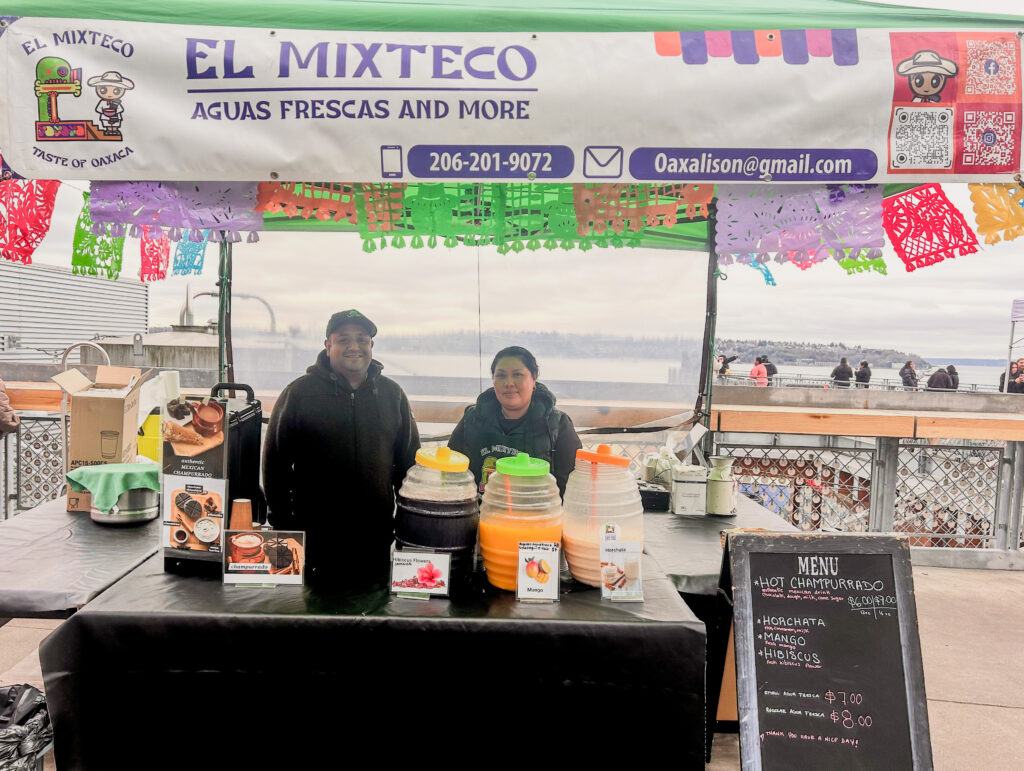
Noemí Cortes, founder of El Mixteco Agua Frescas and More, was one of them. She immigrated to Washington in 2015 from Oaxaca, Mexico, with the intent of supporting her family back home, she said. “Working here, I see many cultures and the opportunities in Seattle for immigrants.”
Cortes first discovered Growing Contigo on Facebook and signed up for the Entrepreneurship Incubator program. “He’s very professional and has a lot of resources for helping businesses and tries to open your ideas,” she said of Vasquez. “He talks about finances, marketing and so many other steps. When I started my business, all I knew how to do was make Aguas Frescas, so José helped me a lot.”
Growing Contigo is a private business, but it functions like a nonprofit organization. Vasquez explained, “The majority of our clients are actually local government agencies or nonprofits who are investing in economic empowerment programs. We’ve been able to find success in partnering agencies like the Washington State Department of Commerce and Seattle’s Office of Economic Development.”
The city of Seattle has contracted Growing Contigo, along with 13 others, for their Accounting and Business Consulting (ABC) program, which offers eligible small businesses up to 10 hours of free consulting.
Cortes participated in the ABC program, where she also worked with Vision 7 Advertising, a Seattle-based firm specializing in brand strategy and digital marketing. There, she received guidance on marketing and social media, including how to make videos and Instagram Reels.
Growing Contigo also hosts pop up markets and outreach campaigns that bring resources and partnerships opportunities into communities.
Although some of their services and events are offered through local chambers and business associations, Vasquez noted that many of his clients or potential clients often can’t use them. “Taking an evening off to go to a class to connect with the local nonprofit or a local chamber means closing their business, so it’s not viable,” he said.
That is why Growing Contigo focuses its efforts on direct outreach. The team visits businesses, knocks on doors and utilizes online resources to identify registered home businesses.
Cervera discovered Growing Contigo through the ABC program while searching for resources and opportunities to continue learning. While working with Ventures, a Seattle nonprofit that supports entrepreneurs with coaching and training, she developed the idea for her business.
She eventually enrolled in the incubator program. “I already had my project started, the main idea, but for me, any opportunity to learn or to present your project and get feedback, is a good one,” she said. “I like that it was in Spanish. That was something that I could connect more with my cohort.”
One of the resources Cervera valued most at Growing Contigo was access to mental-health services, support she said is often overlooked. “For a lot of the Latin people, we are taught to get up and just go to work. You can feel bad later” she said. “It has been very helpful to me having this mentality for success, but it’s also kind of like a double-edged sword.”
What made this experience meaningful, she said, was being able to talk with someone who understood her perspective. “It’s nice to have a specialist that understands you because they’ve been through it. It’s easier for you to explain it in your own language. And it’s something that we’re not used to talking about.”
More recently, clients have been expressing concerns about immigration and rising prices, “We’re hearing from a lot of clients that are losing sales because people are afraid to go out anymore, to go to Mexican restaurants or shop at grocery stores because there is that fear,” Vasquez said.
In Washington State, federal immigration enforcement continues to be active, particularly within Latino communities, contributing to that anxiety.
Vasquez has noticed this attendance drop reflected in their own market events. Some of their clients are losing workers: “One day, they just don’t show up, and the next thing they know they find out a bunch of them got picked up at a work site,” he said.
Growing Contigo, Vasquez said, is working to ensure that businesses know their rights and understand how to protect their employees, their customers and themselves.
Rising costs of resources are also causing anxieties among some of Growing Contigo’s clients. “It’s hard for us to keep our business working because we have to pay a lot of fees,” said Juan Ramirez at El Mixteco. “It’s very important to keep our price close to other people, not too high.”
Under these circumstances Growing Contigo works with businesses to establish a rainy day fund. They want to ensure that in the event of a natural disaster or immigration issues, businesses have saved three to six months’ worth of their monthly expenses.
Vasquez explained that the reason he named the company Growing Contigo is because it means growing with you. “We grow and you grow,” he said.
“I really believe in that sentiment that if we help our community right now, build those fundamental pieces, build that basic infrastructure for building successful businesses, three years down the line, five years down the line, we’re going to be with you hand in hand.”
Katelyn Hewitt is a fourth-year student pursuing a bachelor’s in Journalism & Public Interest Communication, and double minors in Business and Leadership at the University of Washington. With a passion for storytelling, she hopes to pursue a career in film and television.