
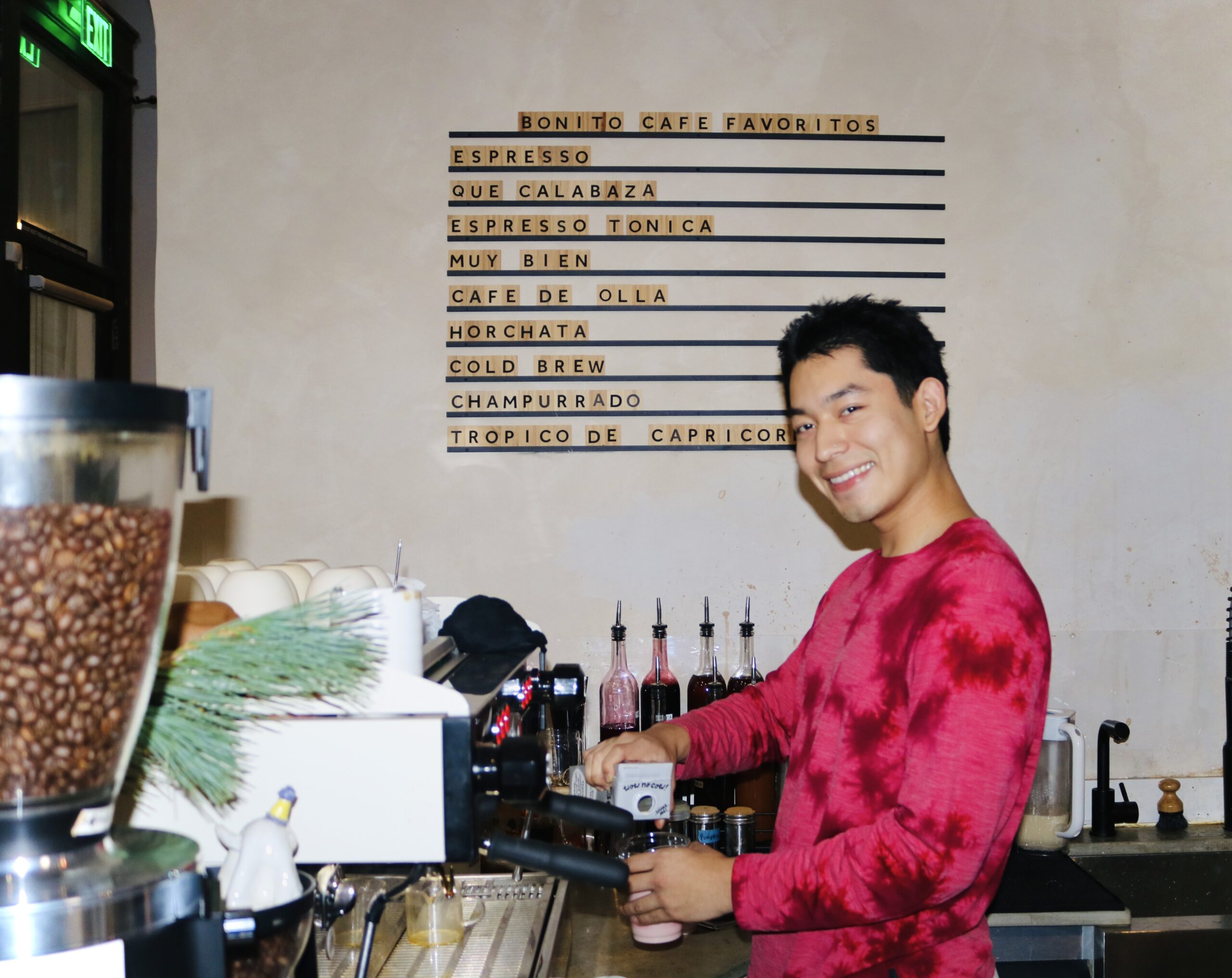
For Maximiliano Urrutia, a barista at the Bonito café in Capital Hill and former photography vendor at Aquí Mercado’s events, the goal has always been about building a space where people can feel safe to express themselves.
The Bonito Café is a Latino and LGBTQ+ owned coffee shop and marketplace, founded in September of 2024 by Daniel and Ismael Calderon, that centers as a scene for community, culture, and creativity.
It is a cousin company of the Aquí Mercado, a beloved Latino and queer festival-style market founded under the same enterprise and owners in April of 2023. The market takes place every couple of months and promotes creativity and uninhibited self-expression through different performers, local artists, foodtrucks, and thousands of visitors who strive to celebrate themselves and their communities.
According to Urrutia, the popularity of Aquí Mercado made it clear that vendors and visitors wanted more frequent opportunities than an occasional pop-up could provide. Opening Bonito Café became a way to offer a stable, accessible venue for the communities.
“Daniel and Ismael emphasized that their café isn’t just make your coffee and go,” said Urrutia, referring to what the founders instilled into him as they opened the shop. “This is a space where those who are marginalized should feel safe to express themselves, make connections and have a good start to their day.”
It does so by promoting a safe space for belonging, whether that is stopping in and working remotely, meeting friends over coffee, or even setting up shop and selling artworks. That spirit is what has led to the growth of this mercado and success of the café. “People just show up and enjoy themselves without worrying who’s watching,” Urrutia said.
The organizers of the café and mercado experiment with different Mexican traditions, celebrations, and culturally rooted themes at their events, including a Las Posadas-inspired mercado in December.
“In the Pacific Northwest, we haven’t always had a big platform to showcase Latino artists. El mercado really opened that door,” said Maria Reyes, a first-generation Latina artist based in Seattle who has had a booth at Aquí Mercado a handful of times.
Reyes works across multiple mediums including stickers, prints, woodburning, and hand-painted sugar skulls, promoting her art through ArtedeMariaReyes. Her work is inspired by her Mexican-American roots and upbringing in Los Angeles, before moving to the PNW when she was 12.
“El mercado has given vendors visibility and shown people that Latino art isn’t just one style – everyone has their own version of what being Latino or LGBTQ+ looks like,” she said.
Reyes has watched the mercado platform expand since she first started. Outdoor mercados like ones at Pier 62 have brought huge crowds of people, as have other partnerships with cities, such as Bellevue.
In early October, Aquí Mercado took to the Eastside to celebrate its first ever Hispanic Heritage Month celebration at The Spring District (TSD), an urban neighborhood in Bellevue that combines office space, apartments and public areas.
The event at The Spring District brought together a multi-ethnic and multi-generational group of around 1,000 people from all over Bellevue and other areas of Seattle, according to Linda Hoffner, TSD’s general manager.
“We’d never seen the space so lively. People stayed for hours – it felt like they just wanted connection and community,” said Hoffner.
“Representation matters. If we can help create space for cultural celebration on the Eastside, that’s exactly the kind of community we want to build.” she said.
Ty Ohman-Myers, the artist behind Lucky Boy Seattle, remembers his first Aquí Mercado vividly.
“I think it was my biggest single day of sales ever,” he said. “And I had a blast. That’s not always the case at markets.”
Ohman-Myers hand-makes bold, playful jewelry designed to encourage people to stretch their creative limits. His brand was born from his own journey of self-expression after moving from Austin, Texas, to Seattle’s Capitol Hill.
“Seattle really empowered me,” he said. “The colors, the queerness, the boldness – it helped me express myself in ways I never could before.”
His relationship with Aquí Mercado began when he found himself working his 9-5 remotely at the Bonito Café, which was promoting local brands through pop-up, in-store activations. He had just taken the leap of creating his own jewelry, and decided to reach out to the organizers of the market.
On weekends, the café gives local artists the opportunity to set up their merchandise and showcase their work. The café often receives more applications than the organizers can accommodate, so openings aren’t always available. In Ohman-Myers’s case, there were no spots left in store, but the team did offer him a place in their upcoming mercado.
After taking this opportunity, Ohman-Myers quickly realized how vibrant and different this mercado was from the rest: “It’s really electric,” Ohman-Myers emphasized regarding the atmosphere. “Its a party, a celebration even – there’s dancing, DJ’s, drag performances and even tattoo artists doing flash. The creativity is off the charts.”
Participating in Aquí Mercado introduced him to a strong, interconnected community of shoppers, performers and fellow creatives.
“You can tell from the outside that they have a tight-knit community, and I’ve been able to build a network there,” he said. “Before this, I didn’t really know anyone else in the maker community. Now people message me about other markets, we collaborate, we support each other. It’s become a community I’m a part of.”
Ohman-Myers strongly appreciates the sense of community, empowerment and success that he has gained from his experiences with Daniel and Ismael Calderon’s establishments – and after all, he was able to get in the queue and set up shop in the loft of the café.
The Bonito Café planted a seed for him that day, and has done so for many other local creatives looking for a space to grow.
As Aquí Mercado prepares for its final event of the year, Urrutia says he hopes newcomers experience the same joy he sees every couple of months at the mercado’s and weekly at the café.
“Everyone just shows up, has fun, and brings the energy of our culture,” Urrutia said.“ And that’s what I want people to feel.”
Libby Whiton