
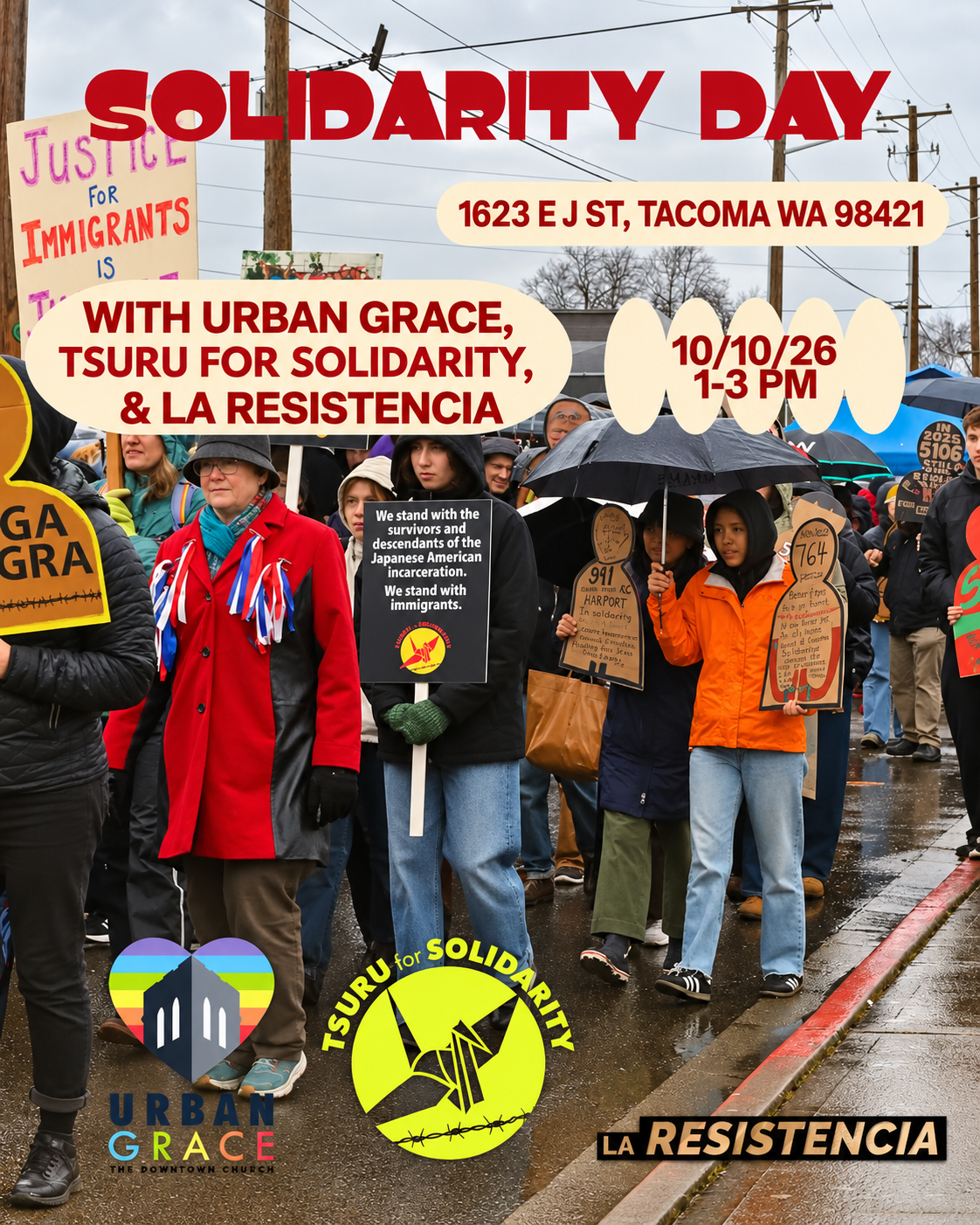
Survivors of Japanese American incarceration during World War II joined Latino immigrant rights advocates, faith leaders and community organizers for a 48-mile pilgrimage across Washington state from October 7 to 10, drawing parallels between the forced imprisonment of Japanese Americans more than eight decades ago and the detention of immigrant families under the Trump administration.
The four-day march, titled From Remembrance to Resistance, was organized by Tsuru for Solidarity in partnership with La Resistencia and the Free Families Coalition. It connected historic sites of Japanese American incarceration with locations central to immigration enforcement today, culminating in a planned gathering outside the Northwest ICE Processing Center in Tacoma.
La Resistencia, a Washington-based grassroots organization led by undocumented immigrants and people directly affected by immigration enforcement, has spent more than a decade fighting to close the Tacoma detention center and advocating for people held inside.
Founded in 2014 during a hunger strike involving more than 1,200 detained immigrants, the organization has become a prominent voice in Washington’s immigrant rights movement. Its work includes supporting detained people and their families, documenting complaints about detention conditions and challenging deportations.
The pilgrimage brought that ongoing campaign together with survivors who experienced government incarceration during World War II.
“I am walking to show my outrage and to oppose immigrant detention,” Reverend Kenji Okohashi, a survivor of Japanese American incarceration during World War II, told Washington Latino News.
“As a Japanese American survivor of WWII concentration camps I know what it feels like to be imprisoned by a government violating its own constitution and laws. History is repeating itself. Having experienced this as a child I know the lifelong damage it can inflict,” Okohashi said.
The march began October 7 in Seattle’s Chinatown International District, where Japanese American families were forcibly removed from their homes in 1942. Participants followed a route through Tukwila, Auburn and Puyallup toward Tacoma, visiting locations connected to both historical incarceration and contemporary immigration enforcement.
Among the locations highlighted was King County International Airport, also known as Boeing Field, where immigrant rights organizations have campaigned against deportation flights.
Organizers called for an end to those flights, the closure of the Northwest ICE Processing Center and an end to what they describe as unauthorized holding rooms for immigrant children and families at a federal immigration facility in Tukwila. The allegations involving the Tukwila facility have not been independently verified by Washington Latino News.
The Tacoma facility, operated by private prison company GEO Group under contract with U.S. Immigration and Customs Enforcement, has long been a focus of demonstrations, hunger strikes and complaints about detention conditions.
For immigrant families in Washington, the campaign raises questions about detention practices, access to legal protections and the consequences of separation from relatives facing deportation.
La Resistencia’s involvement also reflects a broader effort to build solidarity between communities that have experienced detention, displacement and government enforcement policies across different generations.
The historical connection is central to the pilgrimage.
Following President Franklin D. Roosevelt’s Executive Order 9066 in 1942, more than 120,000 people of Japanese ancestry were incarcerated by the U.S. government, approximately two-thirds of them American citizens.
In Washington, more than 7,500 Japanese Americans were imprisoned at the Puyallup Assembly Center, commonly known as Camp Harmony, before being transferred to other incarceration camps.
The Puyallup fairgrounds became one of the pilgrimage’s most significant stops, with organizers scheduling a healing ceremony and a reading of the names of Japanese Americans imprisoned there during World War II.
On October 8, participants also focused attention on the federal immigration facility in Tukwila, where immigration advocates have raised concerns about arrests involving people attending immigration proceedings. U.S. Rep. Adam Smith was among the announced speakers at the gathering.
For participants, the walk offered a way to connect personal memories of injustice with a collective response to current immigration policies.
“I’m impressed by the power of the group, how much more confident and positive I feel, walking with everybody and being together,” Vince Schleitwiler, a Seattle member of Tsuru for Solidarity, told Washington Latino News.
The event was intended to bring attention to people detained inside the facility and the families affected by immigration detention, while renewing demands for the center’s closure.
The Washington pilgrimage was part of a broader national effort to oppose immigration detention and family separation, following a similar march in Texas earlier this year.
For Okohashi, the significance of the demonstration extended beyond remembering what happened to Japanese Americans during World War II.
“We must all now stand up and decide to oppose the cruelty and violence of this administration. We must demand closure of these cruel prisons and free the people inside, especially children,” he said.
Alex Segura is Managing Editor for Latino News Network West, overseeing California Latino News and Washington Latino News. He is a journalist based in California with more than a decade of experience covering U.S. politics, immigration and Latino communities.