
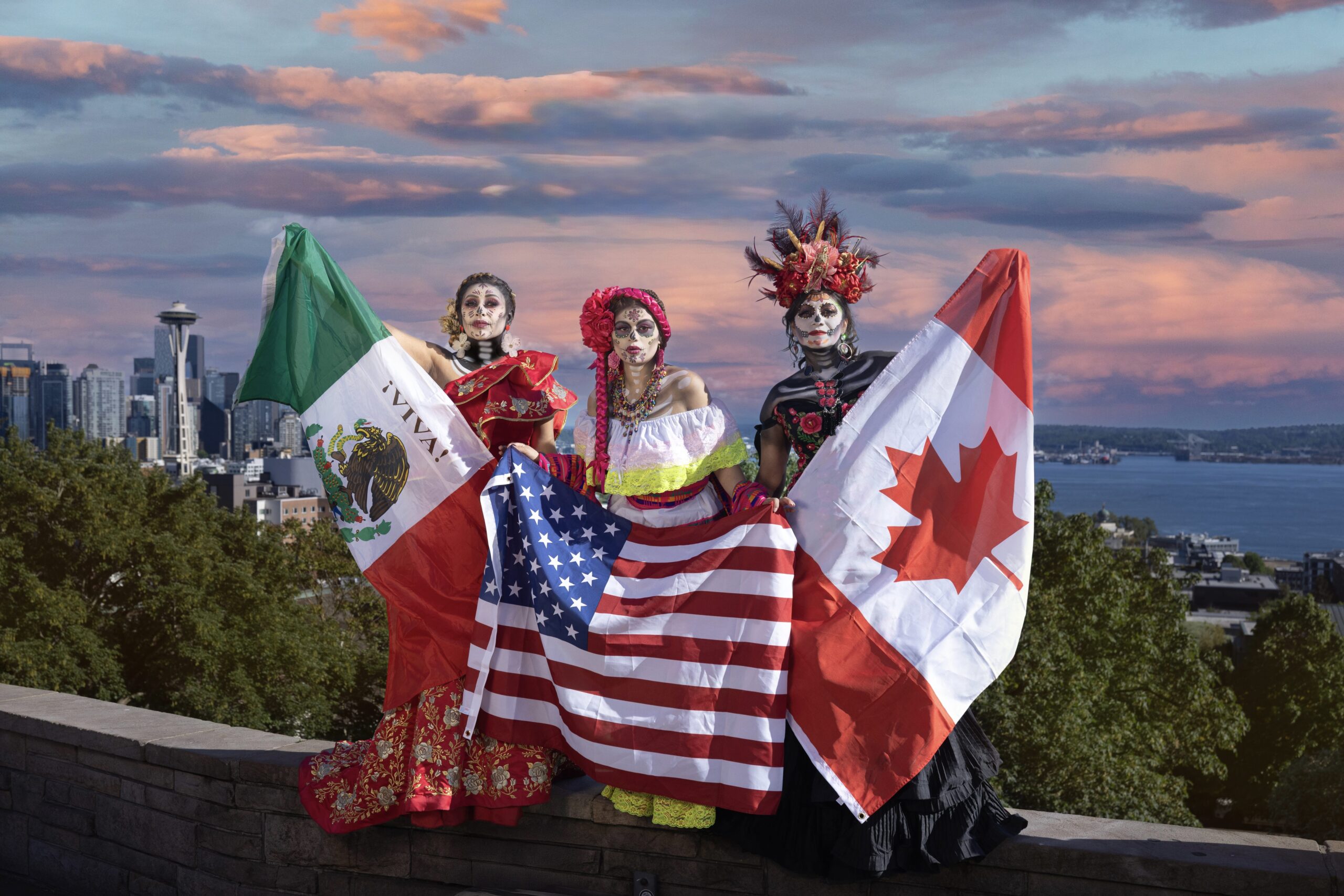
Mundo Catrina, a newly formed cultural arts collective, will be front and center in the Seattle Center on June 11 to celebrate Mexico’s highly anticipated opening match against South Africa in the FIFA World Cup.
Mundo Catrina’s presence is meant to turn a World Cup celebration into something larger: a public display of Mexican identity, immigrant pride and cultural belonging in Seattle.
Founded by Julieta Juarez, a native of Veracruz, Mexico, the project was born out of a desire to represent Mexican culture. While Juarez traditionally transforms into a Catrina every October for Dia de los Muertos (Day of the Dead), she saw the upcoming tournament as a historic milestone for the local community. The Seattle-based organization will feature the iconic figure La Calavera Catrina, brought to life through roughly 75 participants marching through the venue.
“For me, it was very important to bring something that represents us,” Juarez says. “Mundo Catrina is the way that those of us who are outside of our country are going to support Mexico.”
For Juarez, authenticity is everything. The collective is sourcing gowns, rebozos and accessories from artisans in Oaxaca, Guerrero, Jalisco, as well as local shops in Washington. Some gowns weigh between 10 and 15 pounds because of their layered fabrics, long trains, and ruffles. Because these high-quality pieces are culturally irreplaceable, Mundo Catrina is fully insured for the event.
“We are really putting a lot of art into it,” Juarez explains, “And we are trying to be very authentic in what we are doing.”
Mundo Catrina’s dedication to high-quality pieces includes a collaboration with designer Paul Medina, who is custom-designing several of his signature pieces for the event.
Medina’s work blends traditional embroidery with modern elegance. To match his standards, Juarez coordinates the garments to ensure everyone wears authentic art that lasts throughout the parade.
To safely transport these delicate pieces for the upcoming FIFA celebration, Juarez partnered with Luis Solis to manage the logistical side of the project. Solis is responsible for bringing the handmade art directly from Mexico to Seattle. He closely collaborates with folk artisans like Chilapa de Alvarez from Guerrero, who spends roughly 3 months hand-weaving traditional Mexican shawls to keep the shoulders or head warm.
Solis also manages the indoor procession, which requires strict focus on safety to protect both the families attending and the wardrobes. Both Solis and Juarez have intentionally chosen to host the event entirely indoors for this reason.
“We decided to do it within a center where people felt safe and where there is going to be extreme attentiveness,” Solis explains, noting that public spaces can feel risky for the immigrant community amidst the current political climate. “Everything is going to be very controlled within the Seattle Center.”
For Juarez, a lifelong soccer fan who has spent her whole life in stadiums, sees the 2026 games not just as an athletic event. She knows firsthand how fútbol can unite people, and she wants to harness that exact passion into a celebration of cultural identity that gives space to the Seattle community.
While La Calavera Catrina is universally recognized as the icon of Día de los Muertos, her true origin holds deeper historical significance for Mexicans. Far from being a once-a-year tradition, Juarez notes that it is important to represent the figure that unites the community.
Originally sketched by printmaker Jose Guadalupe Posada as a satirical critique of upper-class Mexicans who denied their own indigenous heritage in favor of the European elite, the figure represents the belief that death is not the end, but rather a continuation of life.
Juarez keeps this tradition alive by showcasing La Catrina to celebrate Mexican identity and indigenous roots.
“I have always considered myself to be a woman who wants to conserve art and history,” Juarez says, describing why she looks at La Catrina to guide her vision.
Mundo Catrina is bringing that vision to Seattle. Through vibrant, handmade dresses and detailed skull face paint adorned with bright floral patterns and sparkling gems, the project ensures that Mexican heritage is on display for the world to see.
“We want La Catrina not only to come to Día de los Muertos, we want it to stay all year long, representing it with FIFA,” Solis notes, emphasizing that the symbol of the legendary figure should not be limited to the months of October and November.
Among the 75 Catrinas marching on June 11 is Charlotte Buholm, an 18-year-old high school senior, professional model, and pageant competitor. For Buholm, stepping into the procession means proudly representing her cultural heritage.
Buholm has experience bringing soccer fashion to a stage in Seattle. She previously modeled in a FIFA-themed upcycling fashion show sponsored by Goodwill, where she represented her roots on the runway.
“Walking for Mexico was really special because I got to show everyone who I am and where I come from,” Buholm recalls.
As she prepares to spend about three hours getting her makeup done and putting on her floral crown alongside a traditional Catrina gown from Guadalajara Jalisco, she believes this is a powerful way to display her heritage.
For young Latinos in Washington, participating in the procession is a chance to show their authentic identity to a global audience without filtering who they are.
“Representing my culture means everything to me, and I am excited to be a part of Mundo Catrina,” Buholm says. “It’s beautiful that we get to show the entire world our art, our history, and our true Mexican culture.”
As Mundo Catrina moves to create space for the Seattle Community, this procession stands as a promise to the next generation that their heritage is present. Even after the FIFA World Cup ends, Solis believes that La Calavera Catrina is here to stay.
“Catrina came here to Seattle, crossing borders,” Solis says. “And came here to stay and be a representative symbol for our Mexican culture.”
Anaelsin Lopez, a senior at the University of Washington, is pursuing a degree in Journalism
and Public Interest Communications, alongside a minor in Law, Societies, and Justice. As a
journalist, storyteller, and community advocate, she focuses on creative storytelling to amplify
community voices.